
Chakra healing for beginners starts with one simple idea: your body holds energy, and when that energy feels stuck, your mind and mood can feel stuck too. This guide explains the basics in plain language and gives you easy steps to start today.
In this guide
- What Is Chakra Healing for Beginners?
- The 7 Chakras Meaning
- Blocked Chakra Symptoms
- Chakra Balancing Techniques
- Using Aura Cleanser in Your Practice
- A 10-Minute Chakra Healing Routine for Beginners
- Common Beginner Mistakes
- Chakra Healing for Beginners: FAQs
- Final Thoughts
What Is Chakra Healing for Beginners?
The word chakra comes from Sanskrit and means “wheel.” In traditions that began in ancient India, chakras are spinning centers of energy along the spine.
You can read more about the history in Britannica’s overview of chakras.
Chakra healing is the practice of clearing and balancing these centers. It uses calming tools such as meditation, breathing, movement, sound, and mindful cleansing rituals.
Think of it as a wellness habit, not a medical treatment. Many people use it to feel calmer, more grounded, and more connected to themselves.
At GeetVeda, we share these Vedic ideas as gentle tools for self-care. You do not need any special background to begin, and chakra healing for beginners can be learned at your own pace in just a few minutes a day.
The 7 Chakras Meaning: A Quick Guide
Each chakra links to a part of the body and an area of life. Here is the 7 chakras meaning in short, simple terms.
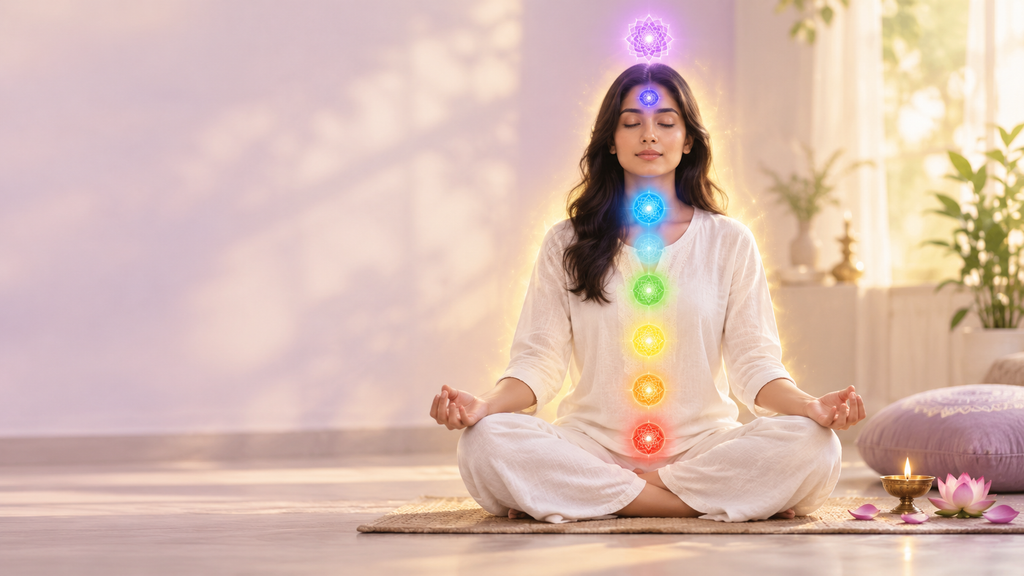
1. Root Chakra (Muladhara)
Located at the base of the spine. It relates to safety, stability, and feeling at home in your body. Color: red.
When it feels balanced, you feel secure and calm under pressure.
2. Sacral Chakra (Svadhisthana)
Located below the navel. It relates to creativity, pleasure, and emotional flow. Color: orange.
When it feels balanced, you enjoy life and express your feelings with ease.
3. Solar Plexus Chakra (Manipura)
Located in the upper belly. It relates to confidence, willpower, and self-worth. Color: yellow.
When it feels balanced, you make decisions with clarity and trust yourself.
4. Heart Chakra (Anahata)
Located at the center of the chest. It relates to love, compassion, and forgiveness. Color: green.
When it feels balanced, you give and receive love openly.
5. Throat Chakra (Vishuddha)
Located at the throat. It relates to honest communication and self-expression. Color: blue.
When it feels balanced, you speak your truth kindly and listen well.
6. Third Eye Chakra (Ajna)
Located between the eyebrows. It relates to intuition, focus, and insight. Color: indigo.
When it feels balanced, you trust your inner voice and see the bigger picture.
7. Crown Chakra (Sahasrara)
Located at the top of the head. It relates to purpose, awareness, and spiritual connection. Color: violet or white.
When it feels balanced, you feel peaceful and connected to something larger than yourself.
Blocked Chakra Symptoms: How to Tell
In chakra practice, a “blocked” chakra means that energy feels stuck or out of balance. These are common blocked chakra symptoms people describe:
- Root: anxiety, money worries, feeling unsafe or scattered.
- Sacral: creative ruts, low motivation, emotional ups and downs.
- Solar plexus: self-doubt, indecision, people-pleasing.
- Heart: loneliness, resentment, trouble trusting others.
- Throat: fear of speaking up, or talking without listening.
- Third eye: brain fog, poor focus, ignoring your gut feeling.
- Crown: feeling disconnected, cynical, or without purpose.
A Simple Self-Check
Sit quietly and scan your body from the base of your spine to the top of your head. Notice where you feel tension, heaviness, or numbness.
Then ask yourself which area of life feels hardest right now. The match between the two often shows you where to begin.
These signs overlap with everyday stress. If you have ongoing physical or mental health symptoms, please speak with a doctor or licensed professional.
Chakra Balancing Techniques to Try at Home
You do not need special skills. These simple chakra balancing techniques fit into a normal day and make chakra healing for beginners feel easy.
Meditation and Visualization
For chakra healing for beginners, meditation is the easiest place to start. Sit quietly and picture each chakra as a glowing wheel of its color. Spend one minute on each, moving from root to crown.
Research from the National Center for Complementary and Integrative Health shows meditation can help with stress and well-being.
Breathwork
Slow belly breathing calms the body fast. Breathe in for four counts and out for six while you rest your hand on the chakra you want to focus on.
Yoga and Gentle Movement
Poses like Child’s Pose (root), Cat-Cow (sacral), Boat Pose (solar plexus), Camel (heart), and Fish Pose (throat) are often paired with chakras.
Sound, Color, and Crystals
Humming, singing bowls, and chakra-colored objects give your mind an anchor. They are tools for focus, and many people find them soothing.
Journaling and Affirmations
Write down one feeling for each chakra after your practice. Add a short affirmation, such as “I am safe” for the root or “I speak with honesty” for the throat.
Cleansing Your Space
A tidy, peaceful space helps you relax. Many people also follow Vedic ideas about home energy, and our Vastu consultancy can help you arrange your space with intention.
Using Aura Cleanser in Your Practice
Many traditions clear the energy around you before chakra work. A simple cleansing ritual tells your mind it is time to reset.
The GeetVeda Navgrah Aura Cleanser Spray is an Ayurvedic herbal spray made for this kind of ritual. It is used to refresh your aura, your room, and your meditation corner before you begin.
How to use it:
- Shake the bottle gently.
- Spray around yourself or your space from a comfortable distance.
- Let the mist settle while you take a few calm breaths.
- Begin your meditation or chakra routine.
Ready to try it? Shop Aura Cleanser for chakra healing.
Use it before meditation, prayer, or whenever your space feels heavy. It is a spiritual and wellness product, not a medical treatment.
A 10-Minute Chakra Healing Routine for Beginners
Ready to practice? Here is a gentle routine you can follow once a day. Chakra healing for beginners works best when it is short and consistent.
- Cleanse (2 min): Open a window and use your Aura Cleanser to set your intention.
- Breathe (2 min): Take slow breaths and relax your shoulders.
- Visualize (5 min): Move from root to crown, one color at a time.
- Close (1 min): Say thank you and write down how you feel.
Repeat this chakra healing for beginners routine for two weeks and notice any shifts in sleep, mood, or focus.
Common Beginner Mistakes to Avoid
Most people stumble in the same few places when they start chakra healing for beginners. Here is how to avoid them.
- Doing too much too soon. Ten calm minutes beat an hour of pressure.
- Chasing instant results. Energy practices work slowly, so give them time.
- Ignoring the basics. Sleep, water, and movement matter just as much.
- Skipping professional care. Chakra work supports your life; it never replaces a doctor.
Chakra Healing for Beginners: FAQs
How long does chakra healing take?
There is no fixed timeline. Many beginners notice a calmer mood within a few weeks of daily practice.
Can I balance all 7 chakras at once?
Yes, a short routine can touch all seven. You can also focus on one chakra for a week if it feels more useful.
Do I need crystals or special tools?
No. Your breath and attention are enough. Tools like a cleansing spray, a candle, or soft music simply make the ritual feel special.
Is chakra healing backed by science?
Chakras are a spiritual concept and are not proven by medical science. However, the habits that go with them, such as meditation and slow breathing, are linked to lower stress.
Final Thoughts on Chakra Healing for Beginners
Chakra healing is a personal, gentle practice. There is no perfect way to do it, and you do not need to master all seven chakras at once.
Start with the chakra that feels loudest right now. If you feel anxious and unsettled, begin with the root. If you feel shut down in relationships, spend a few extra minutes on the heart.
Keep your sessions short and regular. Pay attention to small changes, such as deeper sleep, a calmer mood, or clearer focus. A simple journal makes these shifts easier to spot.
Be patient and kind with yourself, because chakra healing for beginners is a skill that grows with time. Some days your meditation will feel deep, and other days it will feel restless. Both are part of the journey.
If you want guidance beyond this article, explore our astrology consultancy or tarot consultancy. You can also browse all GeetVeda products, read more on our wellness blog, or contact us with any questions.
Keep this guide to chakra healing for beginners bookmarked as your starting point, and come back whenever you need a reset.
Disclaimer: Chakra healing is a traditional spiritual and wellness practice and is not a substitute for medical advice, diagnosis, or treatment.reset.